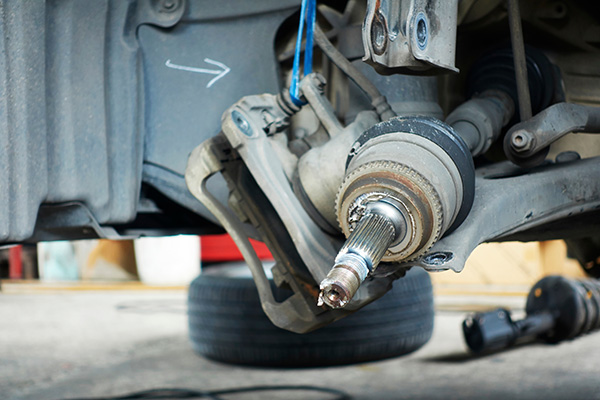
Most drivers do not think much about axles until something starts clicking, vibrating, or feeling wrong while driving. At our shop, that is usually how the conversation starts. Someone comes in and says the car makes a strange noise when turning, or the steering feels off, or there is a grease-like mess near one of the wheels. Then we take a closer look and find that the axle system is where the trouble begins.
Axles are one of those parts of the vehicle that quietly do a huge amount of work. They help transfer power from the engine and transmission to the wheels so your vehicle can actually move. They also deal with turning, suspension movement, bumps in the road, and constant rotation every time you drive. So when an axle starts wearing out or gets damaged, the symptoms can show up in a lot of different ways.
The good news is that axle problems usually leave clues before they become major breakdowns. Understanding what axles do and the common repairs we see can help drivers catch those issues earlier and avoid bigger problems later.
What An Axle Actually Does
At the most basic level, an axle is part of the system that connects power to the wheels. On many vehicles, especially front wheel drive cars and crossovers, the drive axles are what take power from the transmission and send it to the front wheels. On rear wheel drive and all wheel drive vehicles, the design can be a little different, but the basic job is the same. The axle helps make sure the wheel gets the power it needs to turn.
Modern axles usually work together with constant velocity joints, often called CV joints. These joints are what allow the axle to keep sending power while the suspension moves up and down and while the wheels turn left and right. That is a big deal because without that flexibility, the vehicle would not drive smoothly or steer the way it should.
So while people often say axle as if it is one simple piece, there is usually more going on. The axle assembly often includes the shaft itself, the CV joints, and the protective rubber boots that keep grease in and contaminants out.
Why Axles Wear Out
Axles are built to be durable, but they are not indestructible. Over time, normal driving wear adds up. Potholes, rough roads, hard turns, curb impacts, lifted or lowered suspension setups, and torn CV boots can all shorten axle life.
One of the biggest reasons axle trouble starts is because a CV boot tears. That boot holds grease around the CV joint and protects it from dirt and moisture. Once it splits open, grease starts leaking out and road grime starts getting in. From there, the joint begins wearing much faster than it should.
This is one reason a small issue can quietly turn into a bigger one. A torn boot may not seem dramatic at first, but if it goes long enough, the entire axle assembly may eventually need replacement.
The Most Common Sign Is Clicking While Turning
This is probably the axle symptom we hear about most often. If you hear a clicking or popping noise while turning, especially during tighter turns, that often points to a worn outer CV joint. The sound happens because the joint is no longer moving smoothly under load. Instead of operating quietly, it starts making itself known every time the wheel turns and power is applied.
At our shop, when someone says the car clicks during turns, the axle is always high on the list of things we want to inspect.
Grease Around The Inside Of A Wheel
A torn CV boot often gives itself away with grease splattered around the inner wheel area, suspension, or undercarriage nearby. This is one of the easiest visual signs of axle trouble. That grease is supposed to stay sealed inside the boot, packed around the joint. If it is being thrown out onto surrounding parts, the boot is no longer doing its job.
Sometimes drivers catch this early enough that the joint has not completely failed yet. Other times, by the time the grease is visible, the damage has already started inside the joint. That is why it is worth having it checked sooner rather than later.
Vibration While Accelerating
Another common axle-related complaint is vibration that shows up during acceleration. A worn or damaged inner CV joint can sometimes cause the vehicle to shake or vibrate when power is being applied, especially at certain speeds.
This can feel different from a simple tire balance problem. Tire vibration often shows up more consistently at highway speed. Axle-related vibration may feel more tied to acceleration itself. That distinction matters because it helps point the diagnosis in the right direction. If the car feels smooth while coasting but vibrates more when accelerating, we start thinking about axles and drivetrain components much more seriously.
Clunking Or Harsh Movement
In some cases, a worn axle or CV joint can create a clunking sensation when shifting into gear or changing from acceleration to deceleration. If the joint has developed too much play, the movement can feel loose or harsh.
This is not always as obvious as clicking, but it is another sign that something in the axle assembly may be wearing beyond normal limits.
What Common Axle Repairs Look Like
The most common axle-related repairs we see usually fall into a few categories.
CV boot replacement when the damage is caught early
Complete axle assembly replacement when the CV joint is already worn or damaged
Inspection of surrounding suspension or wheel components if the axle issue came after an impact
In some cases, if a boot is torn and the joint is still in good shape, it may be possible to replace the boot and repack the grease. But in real-world shop situations, many axle issues are not caught quite that early. By the time the noise starts or the grease leak is noticed, the more practical and reliable repair is often replacing the complete axle assembly. That is usually the best way to restore smooth operation and avoid repeating the problem shortly after.
Why We Often Replace The Whole Axle
A lot of drivers ask why the whole axle gets replaced instead of just one small part. The reason is usually practicality and reliability. Once a CV joint has been running low on grease or exposed to contamination, internal wear tends to follow. Replacing only the boot at that point may not solve the noise or the wear that is already underway. A complete axle replacement is often the more dependable repair because it restores the full assembly at once. It also tends to make more sense in terms of labor and long-term value. Instead of fixing one part of a worn assembly, you are starting fresh with the whole unit.
What We Check During Diagnosis
When a vehicle comes in with possible axle trouble, we do not just listen for one noise and call it done. We inspect the boots, check for grease loss, look for looseness in the joints, and pay attention to how the vehicle behaves during turning and acceleration.
We also look at the surrounding area because sometimes axle damage happens along with other issues, especially after pothole hits or curb impacts. The goal is to make sure the axle is really the cause and that nothing nearby has also been affected.
Turn to Ming's Auto Repair for Axle Repair
The most common axle problems usually involve worn CV joints, torn boots, grease leaks, clicking during turns, and vibration under acceleration. If your car is clicking while turning, shaking during acceleration, or showing signs of grease around the wheels, bring it to Ming's Auto Repair in Allston, MA. We can inspect the axle system, explain what is going on, and help fix the problem before it gets worse.
Call us today or stop by to schedule an inspection.